The Dutch rank #1 in the world1 in English-as-a-foreign language proficiency; however, there are certain mistakes that they are somewhat prone to make in their use of English, due to interference from peculiarities of the Dutch language. When this happens, it is known as Dutchlish.
Here is a collection of examples of Dutchlish that I have collected over the course of several years of living in The Netherlands.
I will learn you how to skate.
Learn instead of teach
From Dutch leren, which means either learn or teach, depending on context.
When you want, we also have it in white.
When instead of if
Apparently because mixing als (=if) with waneer (=when) is also a common mistake in Dutch.
Let's meet at sex.
Sex instead of six
From Dutch zes, which means six. This is not really a common mistake, but it is funny enough to deserve including.
Dear colleagues, hereby the schedule.
Hereby instead of Here is or Hereby I give you.
Because in Dutch, herebij (which means the same as "hereby", and is pronounced very similarly,) can be used alone like that.
We have lot's of bicycle's
In the written word, genitive instead of plural suffix.
Because that is how the plural suffix with -s is written in Dutch.
Meet you at the busstop
In the written word, concatenating words that are not normally concatenated in English.
I swear I can sometimes tell when they do it in the spoken word, or maybe I am just imagining it.
Let's have a telco
Telco instead of teleconference.
For native English-speakers, telco generally does not mean anything, but if it was to mean something, it would perhaps be telecommunications corporation.
Turn on the airco
Airco instead of air-conditioner.
For native English-speakers, airco does not mean anything, but if it was to mean something, it would perhaps be airline company.
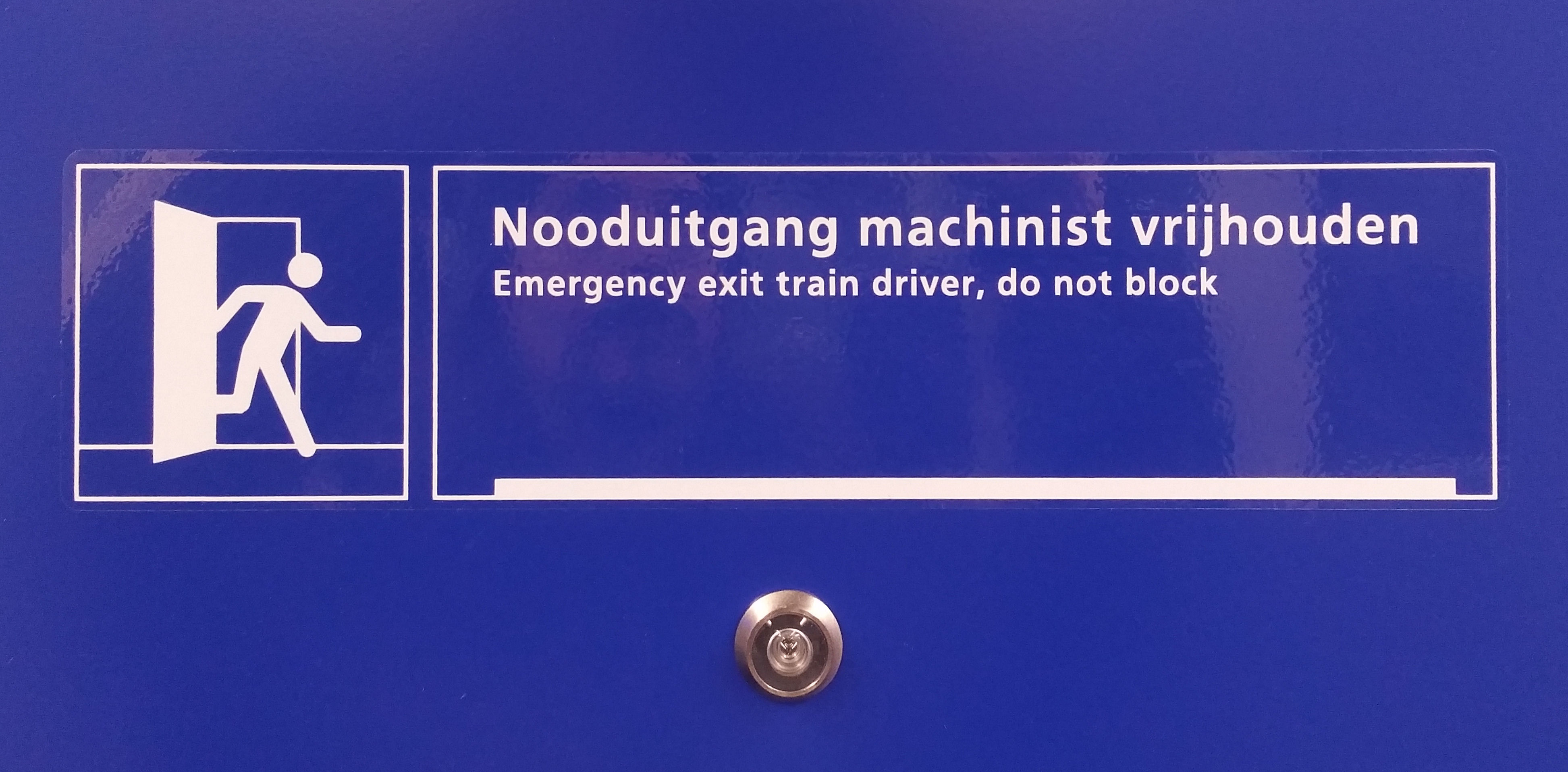
Emergency exit train driver
Object-adjective instead of adjective-object.
 |
|---|
| A sign in virtually every train in the entire little Kingdom of The Netherlands. The Dutch text urges us to not block the train driver's emergency exit. The English translation urges us to not block the driver of the emergency exit train. (What?) |
How long are you?
Long instead of tall.
From Dutch lang, which actually means long, but for some reason that's the word they use when they speak of a person's height. They also have hoog, which means high, but they do not use it for people.
Let's make a photo
Make instead of take for photos.
From Dutch foto maken.
Can I lend your umbrella?
Lend instead of borrow.
From Dutch lenen which means either lend or borrow, depending on context.
You want just the bread?
Bread instead of Hamburger.
No, the McDonald's employee is not seriously considering that you might want nothing but a plain bread bun; they are asking whether you are interested in the combo consisting of hamburger plus fries plus drink, or just the hamburger. Because in Dutch, every edible item that is served on bread is called broodje, which means bread.
Fodavone
In the spoken word, exchanging Fs and Vs.
Dutch pronunciation rules cause some really weird artifacts in the spoken word, for example when you call Vodafone in The Netherlands, the recorded greeting informs you that you have reached "Fodavone".
Cover image: "Dutch Tongue" by michael.gr, based on the logo of The Rolling Stones and the flag of The Netherlands.
English-as-a-second-language proficiency world-wide top rank: See https://www.ef.nl/epi/ ↩︎